 Written by Farrukh Shahzad · November 2, 2026
The UAE remains one of the most attractive places in the world to build a career. Its economy has continued to diversify away from oil, new sectors are growing quickly and the government is actively attracting skilled professionals, entrepreneurs and investors from around the world. For job seekers, that translates into a wide range of work opportunities in the UAE in 2026, from technology and finance to healthcare, tourism, construction and logistics.
This guide looks at the top sectors hiring in the UAE in 2026, the roles in highest demand, which emirates offer which opportunities and how to position yourself to take advantage of them.
Why the UAE offers so many career opportunities
Several long-term factors support strong employment opportunities in the UAE:
- Economic diversification: national strategies aim to grow non-oil sectors such as technology, manufacturing, tourism, logistics and financial services.
- Population growth: a rising population increases demand for housing, schools, healthcare, retail and transport.
- Business-friendly environment: free zones, 100% foreign ownership for many mainland activities and simplified licensing attract new companies every year.
- Long-term visas: Golden Visa and Green Visa options make it easier for skilled professionals to settle long term.
- Global connectivity: major airports, ports and logistics hubs make the UAE a regional headquarters for multinational companies.
- No personal income tax: salaries remain attractive compared with many other countries.
Top sectors hiring in the UAE in 2026
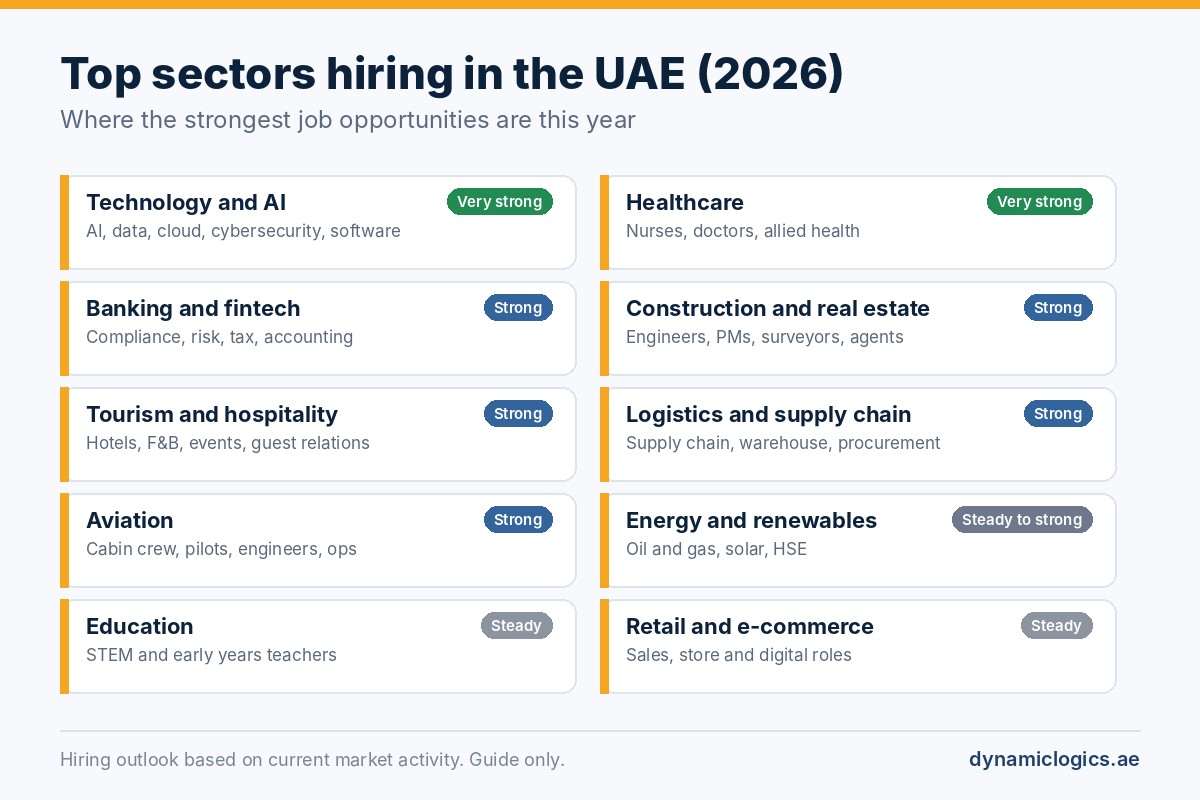
The table below summarises the sectors with the strongest hiring activity and the roles most often in demand.
| Sector | Roles in demand | Hiring outlook |
|---|---|---|
| Technology and AI | AI and data specialists, software engineers, cloud and cybersecurity experts | Very strong |
| Banking, finance and fintech | Compliance, risk, accountants, tax specialists, relationship managers | Strong |
| Healthcare | Nurses, doctors, allied health professionals, healthcare administrators | Very strong |
| Real estate and construction | Civil and MEP engineers, project managers, quantity surveyors, sales agents | Strong |
| Tourism and hospitality | Hotel staff, F&B managers, chefs, guest relations, event professionals | Strong |
| Logistics and supply chain | Supply chain managers, warehouse supervisors, procurement specialists | Strong |
| Energy and renewables | Oil and gas engineers, solar and clean energy specialists, HSE officers | Steady to strong |
| Education | Teachers, especially STEM and early years, school leaders | Steady |
| Retail and e-commerce | Sales associates, store managers, e-commerce and digital marketing roles | Steady |
| Aviation | Cabin crew, pilots, engineers, airport operations staff | Strong |
Technology and artificial intelligence
Technology is the fastest-growing source of career opportunities in the UAE. Government digital transformation, the national AI strategy, smart city projects and new data centres are creating demand for AI engineers, data scientists, cloud architects, cybersecurity analysts, software developers and product managers. Tech professionals with practical experience in AI, cloud platforms and security are among the most sought-after candidates in the country.
Banking, finance and fintech
Dubai and Abu Dhabi are major financial centres, home to DIFC and ADGM. The introduction of corporate tax and ongoing regulatory requirements have increased demand for tax specialists, accountants, compliance officers, AML analysts and auditors. Fintech, digital banking and wealth management are also growing, creating roles for product, risk and technology specialists.
Healthcare
A growing and ageing population, medical tourism and new hospital projects keep healthcare hiring strong. Nurses, specialist doctors, pharmacists, physiotherapists, radiographers and lab technicians are in steady demand. Healthcare professionals need to pass the relevant licensing process (DHA in Dubai, DOH in Abu Dhabi or MOHAP for other emirates) before they can practise.
Construction, real estate and infrastructure
Large-scale residential, commercial and infrastructure projects continue across the country. Civil, structural and MEP engineers, project managers, planning engineers, quantity surveyors, site supervisors and HSE officers are needed. The property market also creates many jobs for real estate agents, property managers and facility management staff.
Tourism, hospitality and events
Tourism is a core pillar of the UAE economy. New hotels, attractions and major events create opportunities for front office staff, chefs, F&B managers, housekeeping supervisors, event planners and guest experience roles. Hospitality is also one of the most accessible sectors for newcomers and freshers.
Logistics, trade and supply chain
With major ports, airports and free zones, the UAE is a global trade hub. E-commerce growth has increased demand for warehouse managers, supply chain analysts, procurement officers, fleet managers and last-mile delivery coordinators.
Energy and renewables
Oil and gas remains a significant employer, especially in Abu Dhabi, while investment in solar, clean energy and sustainability is opening new roles for renewable energy engineers, sustainability consultants and ESG specialists.
Work opportunities by emirate
| Emirate | Key industries and opportunities |
|---|---|
| Dubai | Finance, technology, real estate, tourism, retail, logistics, media and startups |
| Abu Dhabi | Oil and gas, government, healthcare, finance (ADGM), AI and research, culture and tourism |
| Sharjah | Manufacturing, education, trading, logistics, free zones and SMEs |
| Ajman | SMEs, trading, light manufacturing and free zone companies |
| Ras Al Khaimah | Manufacturing, tourism, hospitality and industrial free zones |
| Fujairah | Shipping, ports, oil storage and logistics |
| Umm Al Quwain | Small businesses, free zone companies and tourism |
Skills that open the most doors
Across sectors, certain skills make candidates far more competitive in the UAE job market:
- Digital and data skills: data analysis, AI tools, automation and digital marketing are valued in almost every industry.
- Professional certifications: qualifications such as ACCA, CPA, PMP, CIPS, CFA, AWS or Microsoft certifications and NEBOSH are widely recognised.
- Languages: English is the main business language; Arabic is a strong advantage, especially for client-facing and government-related roles.
- Regional experience: previous GCC experience helps, but strong international experience is also valued.
- Soft skills: adaptability, multicultural teamwork and customer focus are essential in a workforce made up of many nationalities.
Emiratisation and what it means for expats
The UAE has Emiratisation targets that require many private sector companies to increase the share of UAE nationals in their workforce. This creates strong opportunities for Emirati job seekers, particularly in banking, government-related entities and skilled private sector roles. For expatriates, Emiratisation does not close the market, but competition can be higher for some administrative and entry-level positions. Specialist skills, certifications and proven experience remain the best way to stand out.
How to take advantage of UAE work opportunities
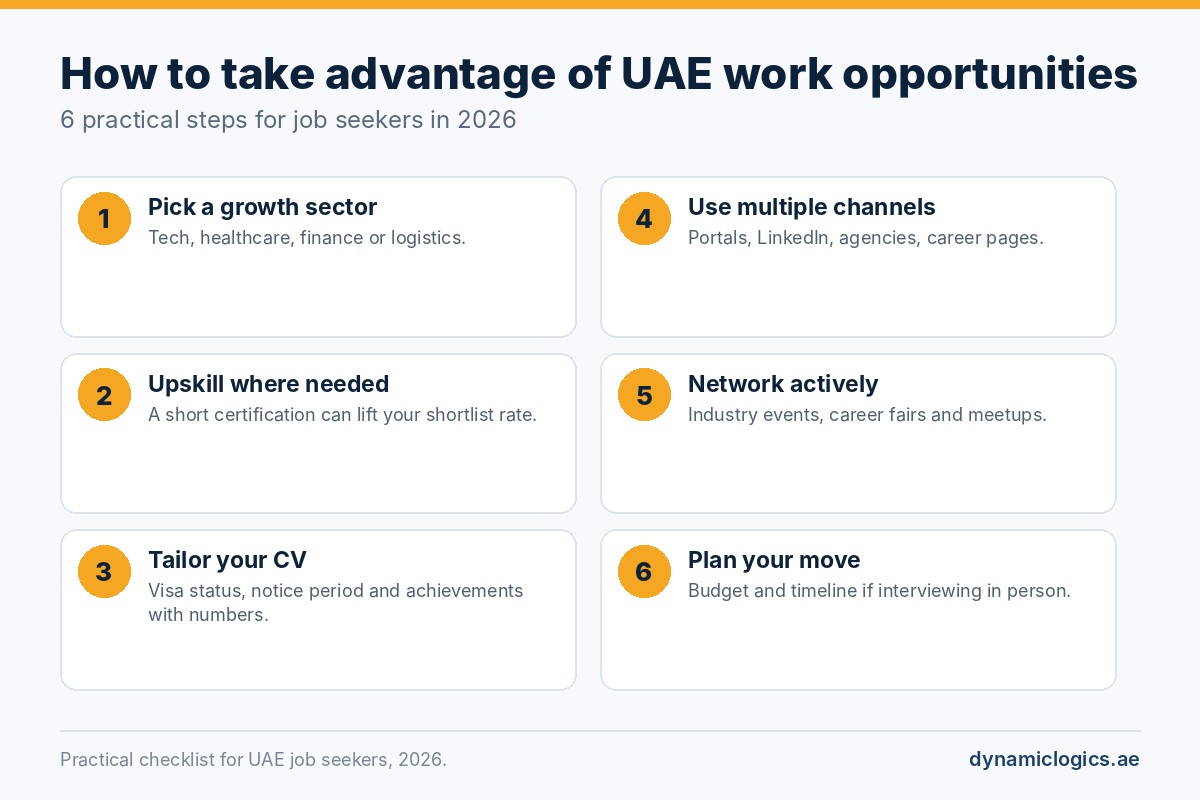
- Pick a growth sector: align your search with sectors that are actively hiring, such as technology, healthcare, finance or logistics.
- Upskill where needed: a short certification can make a big difference to your shortlist rate.
- Tailor your CV for the UAE market: include visa status, notice period, nationality and key achievements with numbers.
- Use multiple channels: combine job portals, LinkedIn, recruitment agencies and company career pages.
- Network actively: attend industry events, career fairs and professional meetups in Dubai and Abu Dhabi.
- Consider visit or job seeker visas: some candidates come to the UAE to interview in person, but always plan your budget and timeline carefully.
Career fairs and events worth attending
Career fairs and industry exhibitions are a good way to meet employers directly. Large events in Dubai and Abu Dhabi often include recruitment sections, graduate fairs and sector-specific exhibitions for technology, healthcare, energy and construction. Bring printed CVs, prepare a short introduction about yourself and follow up with contacts on LinkedIn after the event.
Frequently asked questions
Which sector has the most job opportunities in the UAE?
Technology, healthcare, finance, construction, hospitality and logistics are currently among the sectors with the most job opportunities in the UAE.
Is it easy for foreigners to find work in the UAE?
The UAE is very open to foreign workers, as most of the workforce is expatriate. However, competition is strong, so relevant experience, the right qualifications and a well-targeted CV are important.
Which emirate is best for jobs?
Dubai has the widest range of private sector jobs, while Abu Dhabi offers strong opportunities in energy, government, healthcare and finance. Sharjah and the northern emirates are strong for trading, manufacturing and SMEs.
Are there opportunities for freshers in the UAE?
Yes. Hospitality, retail, sales, customer service, IT support and graduate programmes at large companies all offer entry points for freshers.
Do I need to speak Arabic to work in the UAE?
No, English is the main business language in most private sector jobs. Arabic is an advantage and is required for some government and client-facing roles.
Final thoughts
Work opportunities in the UAE in 2026 are broad and growing, especially in technology, finance, healthcare, construction, tourism and logistics. By focusing on a growth sector, building in-demand skills and using a structured job search strategy, you can position yourself for a rewarding career in one of the world’s most dynamic job markets.
About the author
Farrukh Shahzad
Farrukh Shahzad is a content author at DLMC Consultants, part of a UAE-based corporate services group. He produces informative guides on employment, recruitment, HR and business practices in the United Arab Emirates.