
 Written by Farrukh Shahzad · October 5, 2026
Remote work has become a normal part of working life in the UAE. Many companies now offer hybrid or fully remote roles, and a growing number of residents earn an income online from home, whether as employees of international companies, freelancers or small business owners. At the same time, online job scams are common, so it is important to know which work from home jobs in the UAE are legitimate and what the legal rules are.
This guide explains the most common legit remote jobs you can do from the UAE, typical earnings, the visas and permits that apply, where to find remote jobs and how to avoid scams.
Is remote work legal in the UAE?
Yes. UAE labour law recognises remote and flexible work arrangements, and many employers offer hybrid or remote roles. What matters is your legal status:
- Employees of UAE companies: you can work remotely if your employer agrees. Your residence visa and work permit remain with your employer.
- Remote workers for foreign employers: the UAE offers a virtual work (remote work) visa that allows eligible professionals employed by companies outside the UAE to live in the UAE and work remotely, subject to income and documentation requirements.
- Freelancers: freelancers can obtain a freelance permit or licence from a free zone or relevant authority to work legally with multiple clients.
- Dependants on a family visa: spouses and family members can work, including remotely for a UAE employer, but usually need a work permit.
- Visit visa holders: working on a visit visa is not allowed.
Rules and requirements can change, so always check the latest information on official government portals or with an authorised typing centre before applying.
Legit work from home jobs in the UAE
The table below lists the most common legitimate remote jobs in the UAE and what they typically involve.
| Remote job | What you do | Skills needed |
|---|---|---|
| Software developer | Build and maintain websites, apps and software | Programming, Git, problem solving |
| Digital marketer / SEO specialist | Run campaigns, SEO, social media and analytics | Google Ads, SEO tools, content strategy |
| Content writer / copywriter | Write blogs, website copy, product descriptions and scripts | Strong English, research, SEO basics |
| Graphic designer | Design social media posts, logos, branding and ads | Adobe tools, Canva, Figma |
| Virtual assistant | Email, calendar, research, admin and customer follow-up | Organisation, communication, office tools |
| Remote customer service agent | Answer chats, emails and calls for companies | Communication, patience, CRM tools |
| Bookkeeper / accountant | Manage accounts, VAT records and reports for clients | Accounting software, VAT knowledge |
| Online tutor / teacher | Teach school subjects, languages or skills online | Subject expertise, teaching skills |
| Translator / interpreter | Translate documents or interpret online, often Arabic-English | Fluency in two or more languages |
| Data entry / data annotation | Enter, clean or label data for businesses and AI projects | Accuracy, basic computer skills |
| Medical coder | Convert medical records into standard codes for billing | Medical coding certification |
| Video editor | Edit videos for brands, creators and social media | Premiere Pro, CapCut, DaVinci Resolve |
How much can you earn working from home in the UAE?
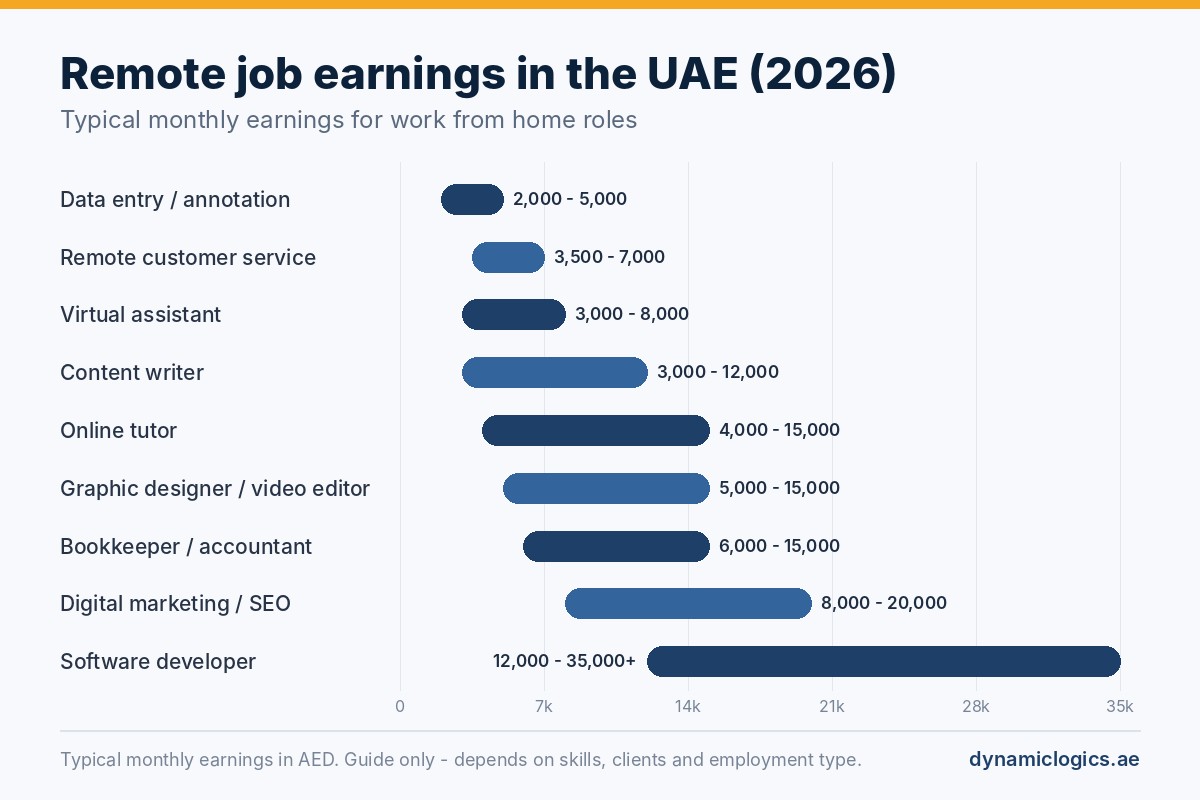
Earnings vary widely depending on your skills, clients and whether you are employed or freelancing. The ranges below are typical monthly earnings for remote workers in the UAE and are meant as a guide only.
| Remote role | Typical monthly earnings (AED) |
|---|---|
| Data entry / annotation | 2,000 to 5,000 |
| Remote customer service | 3,500 to 7,000 |
| Virtual assistant | 3,000 to 8,000 |
| Content writer | 3,000 to 12,000 |
| Online tutor | 4,000 to 15,000 |
| Graphic designer / video editor | 5,000 to 15,000 |
| Bookkeeper / accountant | 6,000 to 15,000 |
| Digital marketing / SEO specialist | 8,000 to 20,000 |
| Software developer | 12,000 to 35,000+ |
Visas and permits for remote work
Virtual work (remote work) visa
The UAE’s virtual work visa is designed for professionals who are employed by a company outside the UAE or who own a business abroad and want to live in the UAE while working remotely. It allows holders to sponsor family members and access local services. Applicants generally need proof of employment or business ownership, a minimum monthly income set by the authorities, valid health insurance and a passport with sufficient validity.
Freelance permits
Freelancers who want to work with multiple clients can apply for a freelance permit or licence through free zones and government programmes. A freelance permit lets you invoice clients legally and, in many cases, sponsor your own residence visa. Popular freelance activities include marketing, design, writing, IT, consulting, media and education.
Part-time and flexible work permits
The Ministry of Human Resources and Emiratisation (MOHRE) also offers flexible and part-time work permit options, which can allow residents to work for more than one employer under certain conditions.
Where to find legit remote jobs in the UAE
- LinkedIn Jobs: filter by “Remote” or “Hybrid” and location “United Arab Emirates”.
- UAE job portals: Bayt, Naukrigulf, Indeed UAE and GulfTalent all list hybrid and remote roles.
- Global remote job boards: sites dedicated to remote work list international roles open to UAE-based candidates.
- Freelance marketplaces: Upwork, Fiverr and similar platforms connect freelancers with clients worldwide.
- Company career pages: many tech companies, startups and multinationals advertise remote-friendly roles directly.
- Networking: local communities, professional groups and referrals often lead to remote projects.
How to avoid work from home scams in the UAE
Online job scams are common, especially those targeting people looking for easy money from home. Watch out for these red flags:
- You are asked to pay a registration, training or equipment fee before starting.
- The job promises very high income for simple tasks such as liking videos, rating products or “boosting orders”.
- You are contacted unexpectedly on WhatsApp or Telegram by someone offering a job you did not apply for.
- You are asked to deposit money to “unlock” commissions or tasks.
- The company has no website, no verifiable address and uses free email addresses.
- You are asked to share bank login details, OTP codes or your Emirates ID without a clear reason.
Genuine employers do not ask you to pay to get a job. If you suspect a scam, stop communicating, do not send money and report it through official channels.
How to start working from home in the UAE: step by step
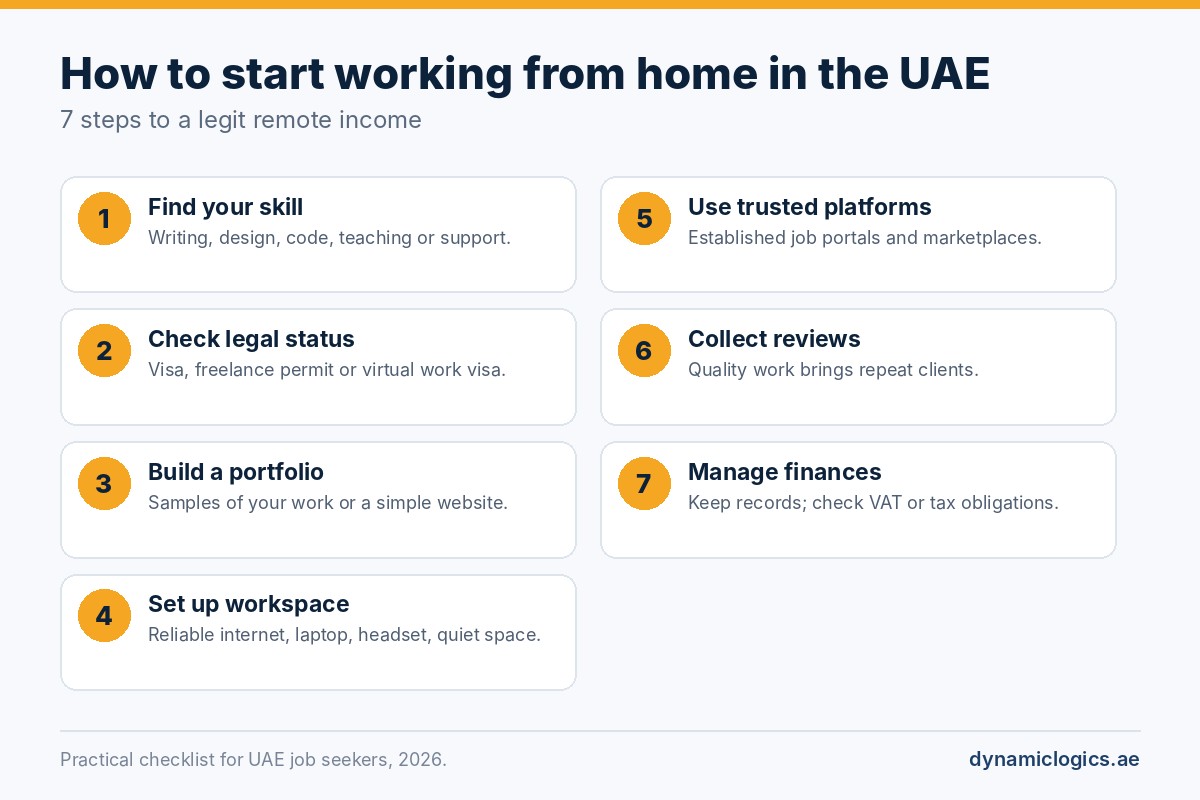
- Identify your marketable skill: writing, design, development, teaching, marketing, accounting or customer service.
- Check your legal status: make sure your visa allows the type of work you plan to do, or apply for a freelance permit or virtual work visa.
- Build a portfolio: create samples of your work or a simple website to showcase your skills.
- Set up your workspace: a reliable internet connection, laptop, headset and quiet area are essential.
- Apply on trusted platforms: start with established job portals and freelance marketplaces.
- Deliver quality and collect reviews: good reviews and referrals bring repeat clients and higher rates.
- Manage your finances: keep records of income, and register for VAT or corporate tax if your business activity requires it.
Remote jobs for students and beginners
Students and beginners can start with roles such as data entry, online tutoring, social media support, content writing, virtual assistance or customer service. These roles help build experience and a portfolio. Students should check what their visa allows, as some types of work may require a permit or employer sponsorship.
Frequently asked questions
Are work from home jobs legal in the UAE?
Yes, as long as you have the right visa or permit. Employees can work remotely with employer approval, while freelancers and remote workers for foreign companies can use a freelance permit or virtual work visa.
What is the best remote job in the UAE?
Software development, digital marketing, data and design roles usually offer the highest earnings. Customer service, tutoring and virtual assistance are easier to start.
Can I work online in the UAE without a permit?
Working without the correct permit can lead to fines and visa problems. It is best to check your status and obtain a freelance permit or the appropriate work permit before earning an income.
How can I earn money from home in the UAE without investment?
Skill-based services such as writing, tutoring, translation, design or virtual assistance need little investment beyond a laptop and internet connection. Avoid any opportunity that asks you to pay upfront.
Is there a remote work visa in the UAE?
Yes. The UAE offers a virtual work visa for eligible people employed by companies outside the UAE, subject to income and documentation requirements.
Final thoughts
Work from home jobs in the UAE are real and growing, from software development and digital marketing to tutoring, design and customer service. Focus on a marketable skill, make sure your visa or permit covers your work, use trusted platforms and stay alert to scams. With the right approach, remote work can give you flexibility and a reliable income while living in the UAE.
About the author
Farrukh Shahzad
Farrukh Shahzad is a content author at DLMC Consultants, part of a UAE-based corporate services group. He produces informative guides on employment, recruitment, HR and business practices in the United Arab Emirates.