In the UAE, a safety officer is not an advisory role — it is an operational one. On a construction site in Dubai, inside an oil refinery in Abu Dhabi, or across a logistics compound in Jebel Ali, the safety officer is the person standing between your workforce and the incidents that shut down projects, injure people, and trigger regulatory penalties. The UAE has tightened HSE enforcement significantly in recent years, and the cost of getting this hire wrong is measured in fines, shutdowns, and — in the worst case — lives.
This guide gives UAE employers a complete, ready-to-use safety officer job description, the certifications and skills to screen for, current 2026 salary benchmarks broken down by experience and industry, sample KPIs, and interview questions that test real competence rather than certificate collecting.
What a safety officer does on a UAE site
A safety officer — often titled HSE Officer (Health, Safety, and Environment Officer) — is responsible for implementing, monitoring, and enforcing health and safety standards on site. In the UAE, that means operating within a specific regulatory framework: federal labour law (administered by MOHRE), the Abu Dhabi Occupational Safety and Health System Framework (OSHAD-SF), Dubai Municipality’s HSE requirements, and free-zone-specific rules such as the Trakhees Safety and Risk Assessment System (SARS) in JAFZA and related zones.
The day-to-day is hands-on. A safety officer conducts site inspections and hazard assessments, delivers toolbox talks to labourers (often in multiple languages or through interpreters), investigates near-misses and incidents, manages the permit-to-work (PTW) system, maintains safety documentation, and acts as the site’s liaison with regulatory authorities.
Safety officer job description template (copy and adapt)
Job title
Safety Officer / HSE Officer (specify the sector where relevant — e.g., Construction Safety Officer, Oil & Gas HSE Officer, Industrial Safety Officer).
Job purpose
To protect the health and safety of all personnel on site by implementing and enforcing the company’s HSE management system, ensuring compliance with UAE regulations and project-specific requirements, and driving a culture of safety awareness.
Key responsibilities
- Conduct daily site inspections and hazard identification walkthroughs.
- Prepare and review risk assessments and method statements (RAMS) for all work activities.
- Deliver toolbox talks and safety inductions for workers, subcontractors, and visitors.
- Manage the permit-to-work (PTW) system for high-risk activities (hot work, confined space entry, work at height, excavation, electrical isolation).
- Investigate incidents, near-misses, and unsafe conditions; prepare incident reports with root-cause analysis and corrective actions.
- Monitor compliance with PPE requirements and enforce their use.
- Maintain safety documentation, inspection records, and regulatory submissions.
- Ensure compliance with applicable UAE regulations, including MOHRE labour safety standards, OSHAD-SF (Abu Dhabi), Dubai Municipality HSE requirements, and any free-zone-specific rules.
- Coordinate emergency drills (fire, evacuation, first aid) and maintain emergency response plans.
- Liaise with regulatory authorities, clients, and third-party auditors during inspections and audits.
- Track and report HSE KPIs (lost-time injuries, near-miss frequency, training completion) to management.
- Support environmental compliance, including waste management and pollution-prevention measures where required.
Requirements
- Diploma or bachelor’s degree in engineering, occupational health and safety, environmental science, or a related technical field.
- NEBOSH International General Certificate (IGC) — the most widely recognised HSE qualification in the UAE and GCC.
- Three or more years of safety officer experience on construction, industrial, or oil-and-gas sites.
- Working knowledge of UAE HSE regulations (MOHRE, OSHAD-SF, Dubai Municipality, Trakhees as relevant).
- Strong incident-investigation and root-cause-analysis skills.
- Ability to prepare risk assessments, method statements, and safety documentation independently.
- Fluent English; ability to communicate safety instructions effectively to a multilingual workforce.
Preferred (nice to have)
- NEBOSH International Diploma (IDIP) or equivalent (e.g., CSP, CMIOSH).
- OSHA 30-Hour Construction or General Industry certification.
- IOSH Managing Safely certification.
- First-aid and fire-safety qualifications.
- Trakhees SARS Card or Dubai Municipality HSE approval.
- Experience with ISO 45001 implementation or auditing.
- Arabic, Hindi, or Urdu language skills.
Certifications that matter in the UAE market
In the UAE HSE job market, certification is the baseline hiring filter:
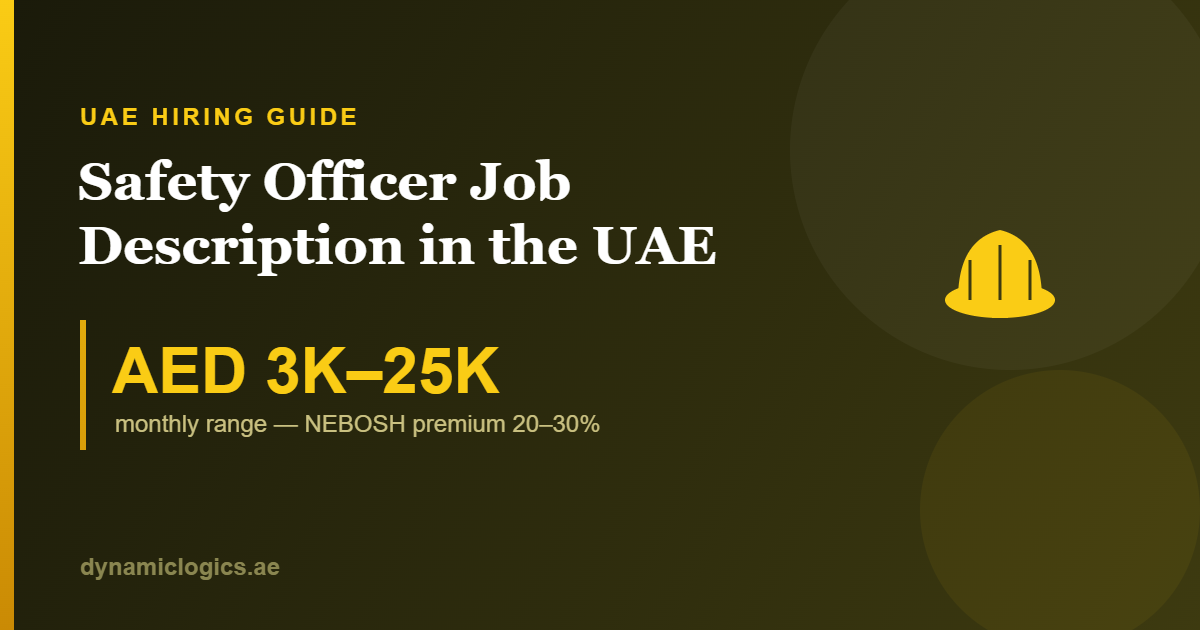
- NEBOSH IGC. The de facto minimum. NEBOSH-certified professionals command a salary premium of roughly 20–30% over non-certified peers.
- NEBOSH International Diploma (IDIP). For senior, specialist, and managerial roles. Holders typically command a further 15–25% premium.
- OSHA 30-Hour. Valued alongside NEBOSH, particularly on projects with US or international contractor involvement.
- IOSH Managing Safely. A solid supporting credential for first supervisory safety roles.
- Trakhees SARS Card / Dubai Municipality HSE Approval. Jurisdiction-specific and mandatory for certain Dubai sites — a legal requirement, not a “nice to have.”
- ISO 45001 Lead Auditor. Valuable for management-system implementation roles.
An honest note: certification alone is not enough. Companies now expect documentation skills, independent risk-assessment capability, leadership on site, and strong English communication alongside the certificate.
Safety officer salary benchmarks in the UAE (2026)
Salaries vary significantly by experience, certification, industry, and emirate. Oil and gas consistently pays the most, followed by large-scale construction, then manufacturing and logistics.
- Fresher / entry-level (0–2 years): approximately AED 3,000–5,000 per month.
- Mid-level HSE officer (3–5 years): approximately AED 5,000–8,000 per month.
- Senior HSE officer (6+ years): approximately AED 8,000–15,000 per month.
- HSE engineer / HSE manager: approximately AED 12,000–25,000 per month.
Indeed UAE, based on over 635 reported salaries (updated April 2026), puts the overall average at around AED 4,000 per month — reflecting the high volume of entry-level roles. Senior and oil-and-gas roles sit well above this.
The HSE salary market has strengthened in 2026, driven by infrastructure investment and tightened regulatory enforcement. Average HSE salaries have reportedly risen 8–12% compared to 2024. All figures are take-home — the UAE does not levy personal income tax.
Industry-specific context
- Construction: The largest employer of safety officers. Physically demanding, large multilingual workforce.
- Oil and gas / petrochemical: Highest-paying sector. Process safety, HAZOP, SIMOPS. Offshore pays more than onshore.
- Manufacturing and industrial: Machine guarding, chemical handling, noise. ISO 45001 experience valued.
- Logistics, warehousing, and free zones: Forklift safety, fire prevention. Trakhees compliance relevant in JAFZA.
- Facilities management: Broad range of building-related risks. Lower-intensity but requires breadth.
Career progression in HSE
- Safety Officer → Senior Safety Officer
- Senior Safety Officer → HSE Engineer
- HSE Engineer → HSE Manager / Head of HSE
- HSE Manager → HSE Director / Regional HSE Lead
Sample KPIs for a safety officer
- LTIFR and TRIR maintained below project targets.
- All PTW documentation completed accurately before work begins.
- Site inspections completed daily with findings documented and closed on time.
- Toolbox talks delivered as scheduled with attendance recorded.
- Near-miss reporting rate (high is healthy).
- Regulatory inspections passed with no major non-conformances.
- Emergency drills conducted on schedule.
Interview questions to screen safety officers
- Walk me through the last incident you investigated. Root cause and corrective actions?
- Describe how you manage the PTW system on a busy site with multiple simultaneous activities.
- A subcontractor’s team is working at height without harnesses. Their supervisor authorised it. What do you do?
- Which UAE regulations apply to this site, and how do you stay current?
- How do you deliver a toolbox talk to a workforce that speaks five different languages?
- Tell me about a time you stopped work for safety reasons and faced pushback.
Common hiring mistakes
Hiring based on certificates alone without testing practical site capability; assuming all NEBOSH holders are equivalent; not verifying jurisdiction-specific approvals (Trakhees SARS Card); and underpaying, which leads to high turnover in a role where continuity directly affects safety culture.
How Dynamic Logics can help
Hiring a safety officer who can actually keep your site compliant and your people safe requires screening that goes beyond the CV. As a Dubai-based recruitment and immigration consultancy with experience across construction, industrial, and oil-and-gas placements, Dynamic Logics verifies certifications, tests practical HSE competence, and confirms jurisdiction-specific approvals before shortlisting. We also handle visa processing and mobilisation. If you need a safety officer who will perform from day one, get in touch.
Frequently asked questions
What qualifications does a safety officer need in the UAE? NEBOSH IGC is the de facto minimum. A diploma or degree in a technical field, plus UAE site experience, are also standard. Some Dubai jurisdictions require a Trakhees SARS Card or Dubai Municipality HSE approval.
How much does a safety officer earn in the UAE in 2026? Entry-level: AED 3,000–5,000/month; mid-level: AED 5,000–8,000; senior/HSE engineer: AED 8,000–25,000. Oil and gas pays the highest. All take-home.
Does NEBOSH certification increase salary? Yes — NEBOSH IGC holders typically earn 20–30% more; Diploma holders earn a further premium.
Which industry pays safety officers the most? Oil and gas, followed by large-scale construction. Offshore roles pay more than onshore.
Related guides
- UAE Salary Guide 2026 — HSE benchmarks.
- UAE Work Visa Guide
- Document Controller JD
Sources
- Salary data: Indeed UAE (635+ reported salaries, April 2026); SmartQHSE UAE HSE Salary Guide 2026; HSE Study Guide (Dubai safety officer salary ranges, 2026).
- Market trends: HSE salaries up 8–12% vs. 2024 (SmartQHSE, May 2026).
- Regulatory: MOHRE; OSHAD-SF; Trakhees SARS; Cabinet Resolution 33/2022.
- No personal income tax: official UAE government portal, u.ae.
Last reviewed: August 2026. Informational only, not legal or employment advice. Salary figures are market estimates.