 Written by Farrukh Shahzad · September 28, 2026
Oil and gas has been the backbone of the UAE economy for decades, and it remains one of the best-paying industries in the country. The UAE is one of the world’s major oil producers, and its national energy companies, international operators and large network of contractors and service companies employ tens of thousands of engineers, technicians, operators and support professionals.
This guide covers the main oil and gas jobs in the UAE, typical salaries, the companies that hire, common rotation schedules, the qualifications you need and how to apply, including for foreigners applying from abroad.
Overview of the UAE oil and gas industry
Most of the UAE’s oil and gas reserves are located in Abu Dhabi, which is home to ADNOC (Abu Dhabi National Oil Company) and its group companies covering upstream exploration and production, offshore operations, gas processing, refining, petrochemicals, drilling and logistics. Dubai, Sharjah and Fujairah also have important energy activities, including gas, storage terminals, trading and marine services.
The industry is divided into three main segments:
- Upstream: exploration, drilling and production of oil and gas, both onshore and offshore.
- Midstream: processing, pipelines, storage terminals and transportation.
- Downstream: refining, petrochemicals, fuel distribution and marketing.
Alongside traditional oil and gas, the sector is investing in gas expansion, carbon capture, hydrogen and lower-carbon operations, creating new types of roles.
Most common oil and gas jobs in the UAE
| Job category | Example roles | Typical work location |
|---|---|---|
| Engineering | Petroleum, reservoir, drilling, process, mechanical, electrical, instrumentation engineers | Head office, onshore and offshore sites |
| Drilling operations | Driller, assistant driller, derrickman, roughneck, toolpusher | Onshore rigs and offshore platforms |
| Production and operations | Production operator, control room operator, plant supervisor | Plants, fields and platforms |
| Maintenance | Mechanical, electrical and instrument technicians, rotating equipment specialists | Plants, refineries and offshore |
| Health, safety and environment | HSE officer, safety supervisor, environmental specialist | All sites |
| Projects and construction | Project manager, planning engineer, QA/QC inspector, piping engineer | EPC contractors and project sites |
| Inspection and integrity | NDT technician, corrosion engineer, welding inspector | Plants, pipelines and offshore |
| Marine and logistics | Marine crew, logistics coordinator, materials controller | Ports, vessels and supply bases |
| Support functions | Procurement, contracts, finance, HR, document control, IT | Offices in Abu Dhabi and Dubai |
Oil and gas salaries in the UAE (2026)
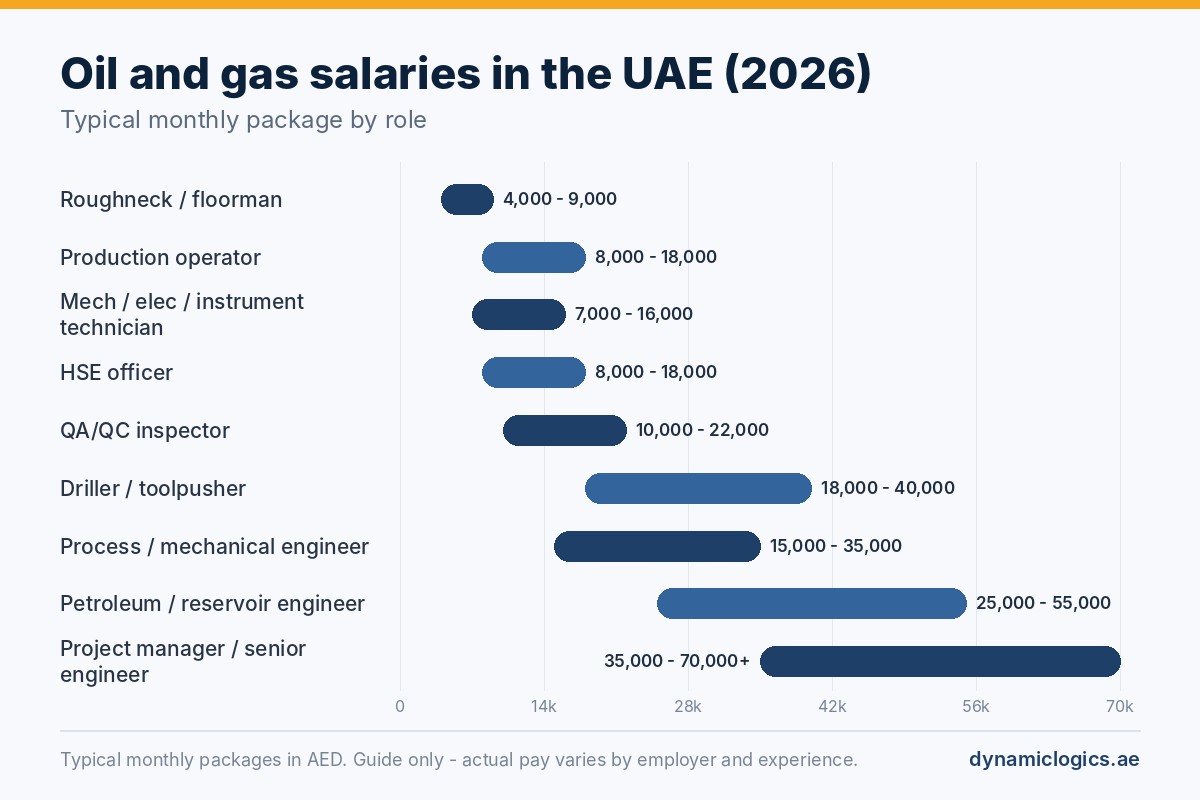
Oil and gas is one of the highest-paying sectors in the UAE. The ranges below are typical monthly packages and are meant as a guide only. National oil companies and international operators usually pay more than smaller contractors, and offshore or rotational roles often include additional allowances.
| Role | Typical monthly package (AED) |
|---|---|
| Roughneck / floorman | 4,000 to 9,000 |
| Production operator | 8,000 to 18,000 |
| Mechanical / electrical / instrument technician | 7,000 to 16,000 |
| HSE officer | 8,000 to 18,000 |
| QA/QC inspector | 10,000 to 22,000 |
| Driller / toolpusher | 18,000 to 40,000 |
| Process / mechanical engineer | 15,000 to 35,000 |
| Petroleum / reservoir engineer | 25,000 to 55,000 |
| Project manager / senior engineer | 35,000 to 70,000+ |
Packages often include housing or accommodation, transport, medical insurance, annual flights and, for site roles, food and camp facilities. Offshore and remote site roles may also include a location or rotation allowance.
Rotation schedules: 28/28 and other patterns
Many field, rig and offshore jobs in the UAE work on rotation. Common patterns include:
- 28/28: 28 days on site followed by 28 days off. Popular for offshore and rig-based roles, and attractive for workers whose families live outside the UAE.
- 14/14 or 21/21: shorter rotations used by some operators and contractors.
- 5/2 or 6/1 field schedules: standard working weeks for onshore plant and project roles, often with long shifts.
Rotational roles usually involve 12-hour shifts, living in a camp or on a platform and following strict safety rules. The time off can be long, but the work while on site is demanding.
Major companies hiring in UAE oil and gas
Employers fall into several groups:
- National energy companies: ADNOC and its group companies are the largest employers in the sector.
- International oil companies and partners: global energy companies participate in UAE concessions and joint ventures.
- Oilfield service companies: international service providers for drilling, wireline, well services and equipment.
- EPC contractors: engineering, procurement and construction firms that build and upgrade plants, pipelines and offshore facilities.
- Manpower and recruitment agencies: many technicians and project staff are hired through specialist agencies on contract.
Qualifications and certifications you need
Requirements depend on the role, but common qualifications include:
- Engineers: a bachelor’s degree in petroleum, chemical, mechanical, electrical or a related engineering field, plus relevant industry experience.
- Technicians: a diploma or technical certificate in mechanical, electrical or instrumentation work.
- Safety training: offshore roles normally require recognised survival and emergency response training such as BOSIET or equivalent, plus H2S awareness.
- HSE certifications: NEBOSH, IOSH or OSHA qualifications are widely requested for safety roles.
- Inspection certifications: ASNT NDT levels, CSWIP, API inspector or AWS welding inspection certifications for QA/QC and integrity roles.
- Drilling certifications: IWCF or IADC well control certification for drilling crews and supervisors.
Previous oil and gas experience, especially in the GCC, is highly valued. Many employers ask for a minimum of three to five years for technical roles.
Oil and gas jobs in the UAE for foreigners
A large part of the oil and gas workforce in the UAE is made up of expatriates from India, Pakistan, the Philippines, the UK, Europe, the US and other countries. Foreign candidates can apply directly to companies, through recruitment agencies or via contractor networks. National energy companies also have Emiratisation targets, so some positions, particularly graduate and administrative roles, may prioritise UAE nationals. Specialist technical skills and certifications remain the best way for expatriates to compete.
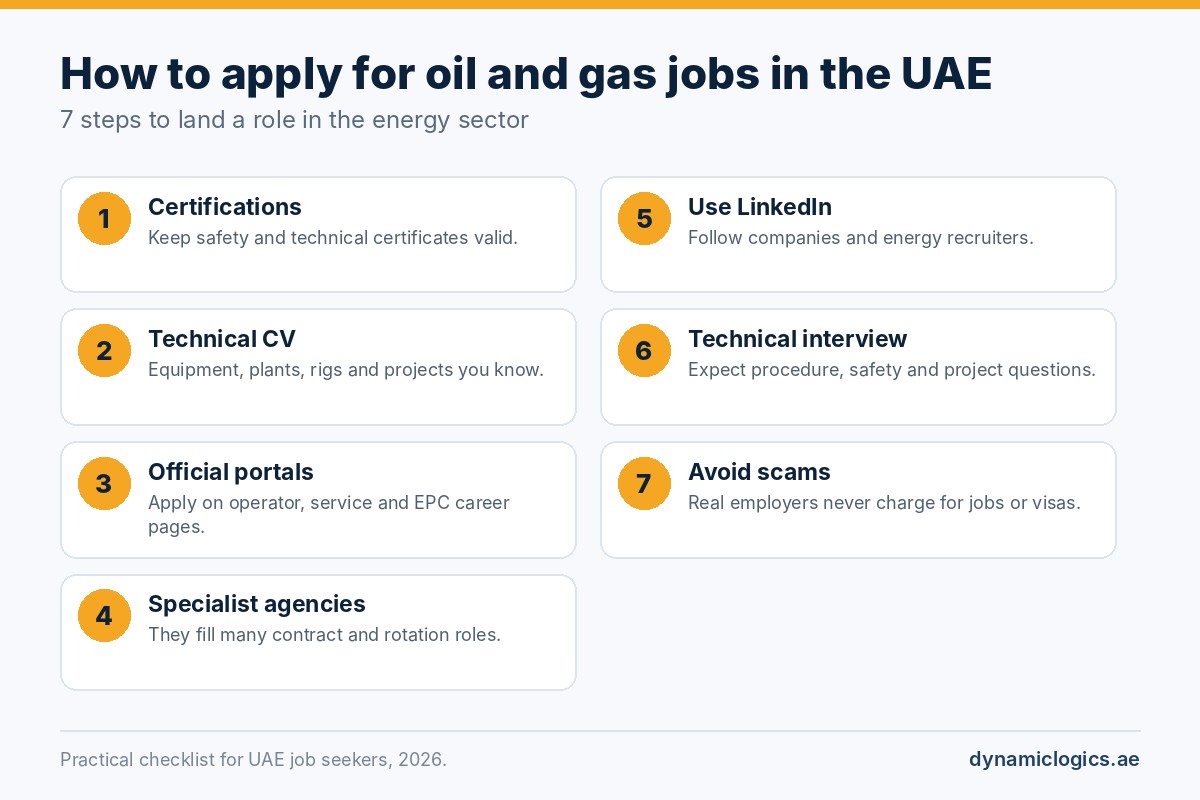
How to apply for oil and gas jobs in the UAE
- Get your certifications in order: make sure your safety, technical and professional certificates are valid and easy to verify.
- Prepare a technical CV: list the equipment, systems, plants or rigs you have worked on, along with project names and responsibilities.
- Apply on official career portals: check the careers pages of energy companies, service companies and EPC contractors.
- Register with specialist agencies: oil and gas recruitment agencies fill many contract and rotational roles.
- Use LinkedIn: follow companies and connect with recruiters who specialise in energy.
- Prepare for technical interviews: expect detailed questions about procedures, safety and past projects.
- Beware of fake job offers: genuine employers never ask candidates to pay for job offers or visas.
Avoiding oil and gas job scams
Because oil and gas jobs are well paid, scammers often use the names of large energy companies to advertise fake vacancies. Warning signs include requests for processing or visa fees, offers made without a proper interview, email addresses from free providers instead of official company domains and pressure to pay quickly. Always apply through official career pages or licensed recruitment agencies, and verify offers before sharing personal documents.
Frequently asked questions
Are oil and gas jobs in the UAE well paid?
Yes. Oil and gas is one of the highest-paying industries in the UAE, with engineers often earning AED 15,000 to AED 55,000 per month and senior roles earning more, tax-free.
Which city has the most oil and gas jobs in the UAE?
Abu Dhabi has the largest concentration of oil and gas jobs, including onshore fields, offshore operations and the headquarters of major energy companies.
What is a 28/28 rotation job?
A 28/28 rotation means working 28 days on site, often offshore or on a rig, followed by 28 days off.
Can foreigners get oil and gas jobs in the UAE?
Yes. Many engineers, technicians and specialists in the UAE oil and gas sector are expatriates. Relevant experience and certifications are usually required.
Do I need offshore training to work on UAE platforms?
Yes. Offshore roles normally require recognised survival and emergency training such as BOSIET or an equivalent, plus a valid medical fitness certificate.
Final thoughts
Oil and gas jobs in the UAE offer excellent pay, long-term career paths and the chance to work on some of the largest energy projects in the world. Build the right technical skills and certifications, target the right employers and agencies, and apply only through official channels to land a rewarding role in the sector.
About the author
Farrukh Shahzad
Farrukh Shahzad is a content author at DLMC Consultants, part of a UAE-based corporate services group. He produces informative guides on employment, recruitment, HR and business practices in the United Arab Emirates.