Hiring an accountant in the UAE is no longer the routine task it once was. Since the introduction of VAT in 2018 and federal corporate tax in 2023, the finance function has moved from record-keeping to genuine compliance risk management — and the accountant you hire now sits at the centre of that. Get the job description right and you attract candidates who can keep your books clean, your filings on time, and your business audit-ready. Get it wrong and you inherit late returns, penalties, and a stack of unreconciled accounts.
This guide gives UAE employers a complete, ready-to-use accountant job description, along with the qualifications to screen for, current 2026 salary benchmarks, sample KPIs, and interview questions. Whether you are a Dubai SME hiring your first in-house accountant or a growing group building out a finance team, you can adapt everything below to your own vacancy.
What an accountant actually does in a UAE company
At its core, an accountant records, classifies, and reports a company’s financial transactions. In the UAE, that baseline comes with a layer of local compliance that did not exist a decade ago. A well-rounded accountant in Dubai or Abu Dhabi today is expected to handle the day-to-day ledger and understand how VAT and corporate tax flow through it.
The role varies by company size. In a small business, one accountant may own the entire finance cycle — invoicing, payments, payroll, VAT returns, and month-end close. In a larger organisation, the same title might be limited to a specific area such as accounts payable, accounts receivable, or general ledger, reporting into a finance manager or chief accountant. Define which version you need before you write the ad, because the two attract very different candidates and command very different salaries.
Accountant job description template (copy and adapt)
Job title
Accountant (specify the focus where relevant — e.g., General Ledger Accountant, AP/AR Accountant, or Senior Accountant).
Job purpose
To maintain accurate financial records, ensure timely and compliant VAT and corporate-tax filings, support month-end and year-end close, and provide reliable financial information that helps management make sound decisions.
Key responsibilities
- Record day-to-day financial transactions and maintain the general ledger.
- Prepare and post journal entries, accruals, and prepayments.
- Manage accounts payable and receivable, including supplier payments and customer collections.
- Perform bank, supplier, and customer reconciliations.
- Prepare and file VAT returns with the Federal Tax Authority (FTA) accurately and on time.
- Support corporate-tax compliance, including data preparation for filings under the UAE corporate tax regime.
- Assist with month-end and year-end closing and prepare financial statements in line with IFRS.
- Process payroll and ensure compliance with the Wage Protection System (WPS).
- Maintain fixed-asset registers and manage depreciation schedules.
- Support internal and external audits by preparing schedules and supporting documentation.
- Monitor cash flow and assist with budgeting and forecasting.
- Ensure financial records comply with company policy and UAE regulations.
Requirements
- Bachelor’s degree in Accounting, Finance, or a related field.
- Two or more years of accounting experience (adjust to your level).
- Working knowledge of UAE VAT and the corporate-tax regime.
- Proficiency in accounting software (for example QuickBooks, Sage, Xero, Zoho Books, SAP, or Oracle) and strong Microsoft Excel skills.
- Understanding of IFRS.
- Strong attention to detail and the ability to meet filing deadlines.
Preferred (nice to have)
- A professional qualification such as ACCA, CPA, CMA, or CA — or active progress toward one.
- Prior UAE experience, particularly with FTA VAT filing and corporate-tax preparation.
- Experience in your specific industry (for example construction, real estate, retail, or financial services).
- Arabic language skills (useful but rarely essential).
Qualifications and skills to screen for
A degree is the baseline, but in the UAE market it is the professional qualification and local tax experience that separate strong candidates from average ones. Certified professionals — ACCA, CPA, or CMA holders — typically command noticeably higher salaries than non-certified peers with similar experience, and they signal a candidate who can operate independently.
Beyond credentials, prioritise these practical skills:
- UAE tax competence. This is now the single biggest differentiator in the market. A candidate who can confidently handle FTA VAT returns and corporate-tax compliance is far more valuable than one who cannot.
- Software fluency. Match this to your stack. SMEs often run QuickBooks, Xero, Zoho Books, or Sage; larger groups run SAP or Oracle. Excel proficiency (pivot tables, lookups) is non-negotiable at every level.
- IFRS knowledge. The UAE uses International Financial Reporting Standards, so candidates should be comfortable preparing statements on that basis.
- Accuracy under deadline. VAT and payroll cycles are unforgiving. Screen for people who treat deadlines as fixed, not flexible.
The UAE compliance context every accountant should know
If you are hiring an accountant, it helps to understand the regulatory backdrop they will be working within, because it shapes what “good” looks like.
- VAT. The UAE has levied value-added tax at a standard rate of 5% since 1 January 2018, administered by the Federal Tax Authority (FTA). Your accountant will typically be responsible for accurate returns and record-keeping.
- Corporate tax. The UAE introduced a federal corporate tax on business profits, effective for financial years starting on or after 1 June 2023, at a headline rate of 9% on taxable profits above the statutory threshold. According to PwC’s Worldwide Tax Summaries, this applies to business profits — not to individual salaries.
- No personal income tax. The UAE government’s official portal states plainly that the UAE does not levy income tax on individuals. In practical terms, the salary figure on an offer letter is the amount that reaches the employee’s account.
- Wage Protection System (WPS). Salaries in the mainland are paid through the WPS, and accountants often manage or support this process.
- Minimum wage. There is no statutory minimum wage for expatriate workers in the UAE; pay is set by contract. Separately, the Ministry of Human Resources and Emiratisation (MOHRE) has moved to set wage floors for Emirati nationals in the private sector.
Accountant salary benchmarks in the UAE (2026)
Salary is where job ads succeed or fail. Publish a realistic range and you attract serious applicants; guess low and the best candidates never apply. Treat every figure below as a directional market range rather than a fixed number, because sector, employer type (SME vs multinational), qualifications, and package structure all move the final offer.
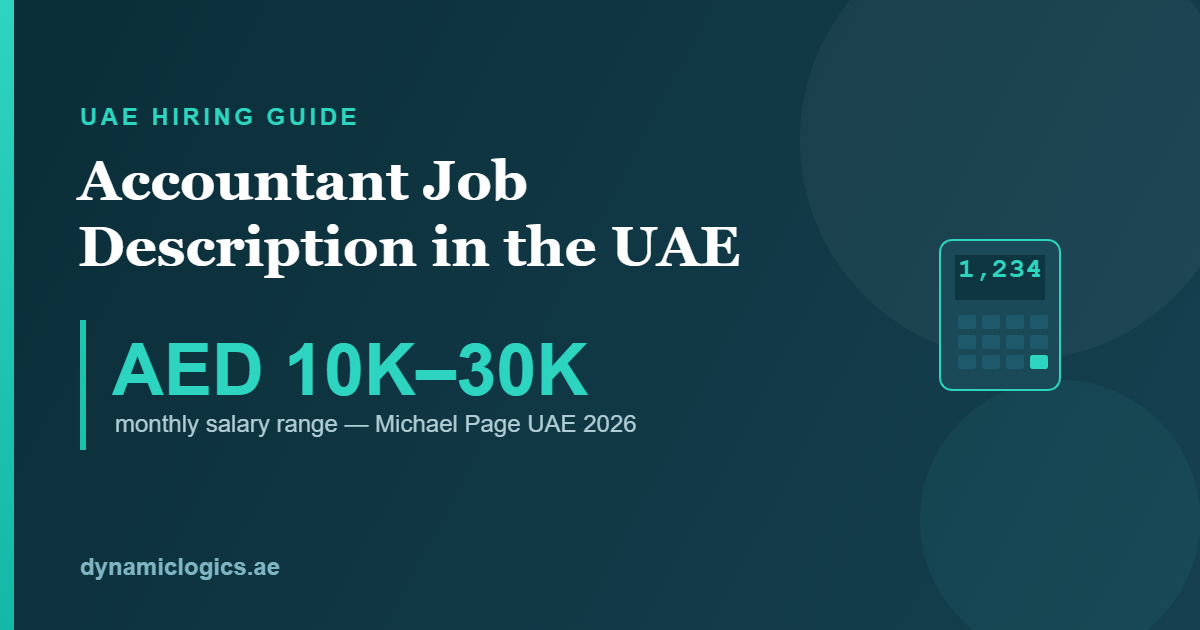
The following monthly base-salary bands are drawn from the Michael Page UAE Salary Guide 2026 (as widely reported in UAE finance coverage in January 2026), which distinguishes between SMEs and multinationals (MNCs):
- Junior / General Accountant: around AED 10,000–15,000 per month at SMEs; AED 14,000–18,000 at MNCs.
- AR/AP Accountant: around AED 12,000–16,000 at SMEs; AED 14,000–18,000 at MNCs.
- General Ledger Accountant: around AED 13,000–18,000 at SMEs; AED 15,000–20,000 at MNCs.
- Senior Accountant: roughly AED 22,000–30,000 per month, with an average near AED 25,000.
- AR/AP Manager: around AED 20,000–25,000 at SMEs; AED 25,000–32,000 at MNCs.
- Payroll Manager: around AED 18,000–22,000 at SMEs; AED 20,000–26,000 at MNCs.
Mid-level qualified accountants and finance managers commonly sit around AED 20,000–27,000 per month, according to the 2026 UAE guides, while newly qualified ACCA professionals are frequently benchmarked at roughly AED 180,000–270,000 per year. At the top of the ladder, chief accountant, finance manager, and CFO packages rise well beyond these bands.
Two market signals are worth factoring into your budget for 2026. First, pay growth is modest rather than explosive: Cooper Fitch’s UAE Salary Guide 2026 pointed to an average expected salary rise of around 1.6% across the UAE. Second, demand is real: the Hays GCC Salary Guide 2026, based on responses from more than 1,600 employers and professionals, reported that a large majority of organisations increased headcount in the prior year and that skills gaps remain widespread.
Career levels: mapping the finance ladder
Understanding the progression helps you title the role correctly and set expectations:
- Junior / Assistant Accountant: supports the ledger, data entry, invoicing, and reconciliations.
- Accountant (General Ledger / AP / AR): owns a defined area of the accounts and month-end tasks.
- Senior Accountant: handles complex reconciliations, VAT and corporate-tax preparation, and often reviews juniors’ work.
- Chief Accountant / Finance Manager: owns the close, financial statements, and compliance, and manages the finance team.
- Financial Controller / CFO: owns financial strategy, controls, and reporting for the whole organisation.
Sample KPIs for an accountant
Adding measurable KPIs to your job description sets clear expectations and makes performance reviews objective:
- VAT and corporate-tax returns filed accurately and before the deadline, with zero penalties.
- Month-end close completed within the target number of working days.
- Bank and supplier reconciliations completed on schedule with no unexplained variances.
- Accounts payable and receivable kept within agreed ageing targets.
- Clean internal and external audits with minimal adjustments.
- Payroll processed accurately and on time through WPS.
How to write a job ad that attracts strong candidates
The job description is your first filter. A few practices consistently improve the quality of applicants:
- Publish a salary range. In a market where candidates benchmark aggressively against public salary guides, a stated range builds trust and reduces late-stage drop-offs.
- Be specific about the tax scope. “Responsible for FTA VAT returns and corporate-tax preparation” attracts the tax-literate candidates who are worth the most and screens out those who aren’t.
- Name your software. Candidates self-select faster when they see whether you run QuickBooks, Xero, SAP, or Oracle.
- State the visa and package clearly. Expatriate professionals need employer-sponsored residency; being upfront about visa sponsorship, medical insurance, and any allowances sets you apart.
- Time your hiring. UAE finance hiring tends to peak in the first and third quarters, around budget and fiscal-year cycles. Posting in those windows widens your candidate pool.
Interview questions to screen accountants
- Walk me through how you prepare and file a UAE VAT return. What checks do you run before submitting?
- What has your involvement been with UAE corporate-tax compliance so far?
- Describe your month-end close process and how you keep it on schedule.
- Which accounting systems have you used, and how do you rate your Excel skills?
- Tell me about a time you found and fixed a material error before it reached the financial statements.
- How do you keep your VAT and corporate-tax knowledge current as regulations evolve?
Common hiring mistakes to avoid
Employers most often go wrong by hiring on credentials alone without testing practical tax competence, by writing a generic ad that fails to specify the UAE compliance scope, or by setting a salary band below the market and then wondering why applications are thin. A short, scenario-based screening task — asking a candidate to walk through a VAT return or a reconciliation — reveals far more than a CV.
Onboarding your new accountant
Once hired, a structured onboarding accelerates value: give the new accountant access to the accounting system, prior filings, the chart of accounts, and current VAT and corporate-tax records early, and set clear expectations for the first close under their ownership. Because finance roles touch confidential data, pair access with the appropriate controls from day one.
How Dynamic Logics can help
Finding an accountant who combines clean bookkeeping with genuine UAE tax competence is harder than the volume of applicants suggests — many CVs look similar until you test them. As a Dubai-based recruitment and immigration consultancy, Dynamic Logics screens finance candidates for exactly this: verified qualifications, hands-on FTA VAT and corporate-tax experience, and the right fit for your company size and sector. We also support the visa and onboarding steps that follow the offer. If you are hiring an accountant or building a finance team, we can help you get it right the first time.
Frequently asked questions
What qualifications should a UAE accountant have? A bachelor’s degree in accounting or finance is the baseline. A professional qualification (ACCA, CPA, CMA, or CA) and hands-on UAE VAT and corporate-tax experience significantly strengthen a candidate and typically command higher pay.
How much does an accountant earn in the UAE in 2026? Monthly base salaries commonly range from around AED 10,000–15,000 for junior accountants to AED 22,000–30,000 for senior accountants, per the Michael Page UAE Salary Guide 2026, with managers and controllers earning more.
Do accountants in the UAE need to know about corporate tax? Increasingly, yes. Since the corporate-tax regime took effect for financial years starting on or after 1 June 2023, tax competence has become one of the most valued skills for UAE accountants.
Is a professional qualification necessary? Not strictly, but ACCA, CPA, or CMA holders are in strong demand and generally earn more than non-certified peers at the same experience level.
Related guides
- UAE Salary Guide 2026 — full finance salary breakdown.
- UAE Employment Contract Guide
- Interview Questions by Role
Sources
- Salary benchmarks: Michael Page UAE Salary Guide 2026 (finance and accounting role bands, SME vs. MNC), as reported by The Finance Story, January 2026.
- Market outlook: Cooper Fitch UAE Salary Guide 2026 (1.6% average salary rise); Hays GCC Salary Guide 2026 (headcount growth and skills gaps across 1,600+ employers).
- UAE corporate tax: effective for financial years starting on or after 1 June 2023 at 9% on profits above the threshold; PwC Worldwide Tax Summaries (UAE), reviewed March 2026.
- No personal income tax in the UAE: official UAE government portal, u.ae.
- UAE VAT at 5%: Federal Tax Authority (tax.gov.ae), effective 1 January 2018.
Last reviewed: August 2026. This article is for informational purposes only and does not constitute legal, tax, or employment advice. Salary figures are market estimates and vary by employer, sector, and individual circumstances.